How the climb unfolds
Gradients you feel before you see
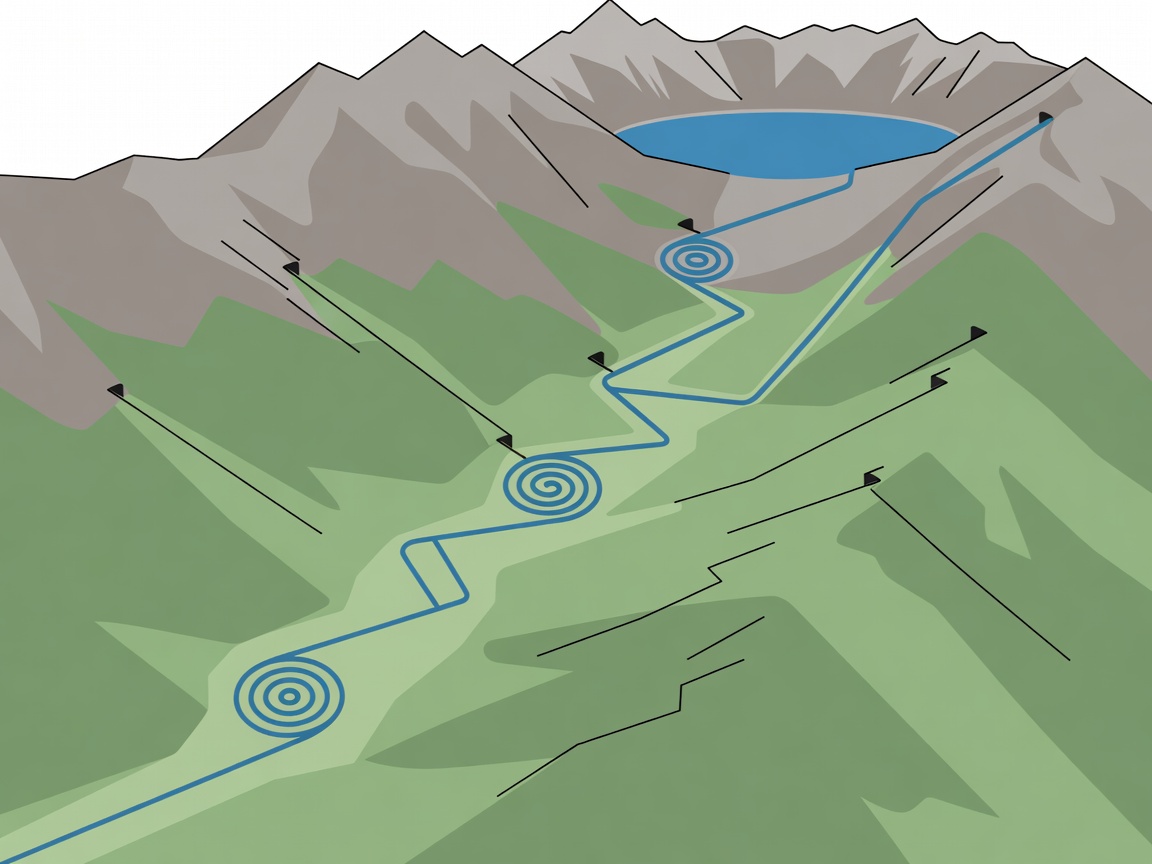
A mountain railway announces itself gradually. The valley floor gives way to orchards, the locomotive note deepens, and the line begins to fold back on itself. On adhesion railways — those that rely only on the grip of steel wheels on steel rails — engineers gained height with long loops, spiral tunnels and horseshoe curves. That is why, on the Albula line in Switzerland, you can glimpse the same church tower three times from three different heights.
Where gradients become too steep for adhesion, a toothed rack rail takes over. The Jungfraubahn climbs inside the Eiger and Mönch to Jungfraujoch at about 3,454 m; Wales's Snowdon Mountain Railway has used rack traction since 1896. Rack sections are slower, and the change of pace is part of the experience: the train seems to lean into the mountain.
For the traveller, the scenic payoff is constant reframing. A view that fills the left windows on one curve swings to the right on the next, so a mountain journey is less a single panorama than a sequence of chapters.
Journey summaries
Four mountain lines worth the window seat
Bernina Express
- Chur – Tirano
- About 4 hours
- UNESCO line
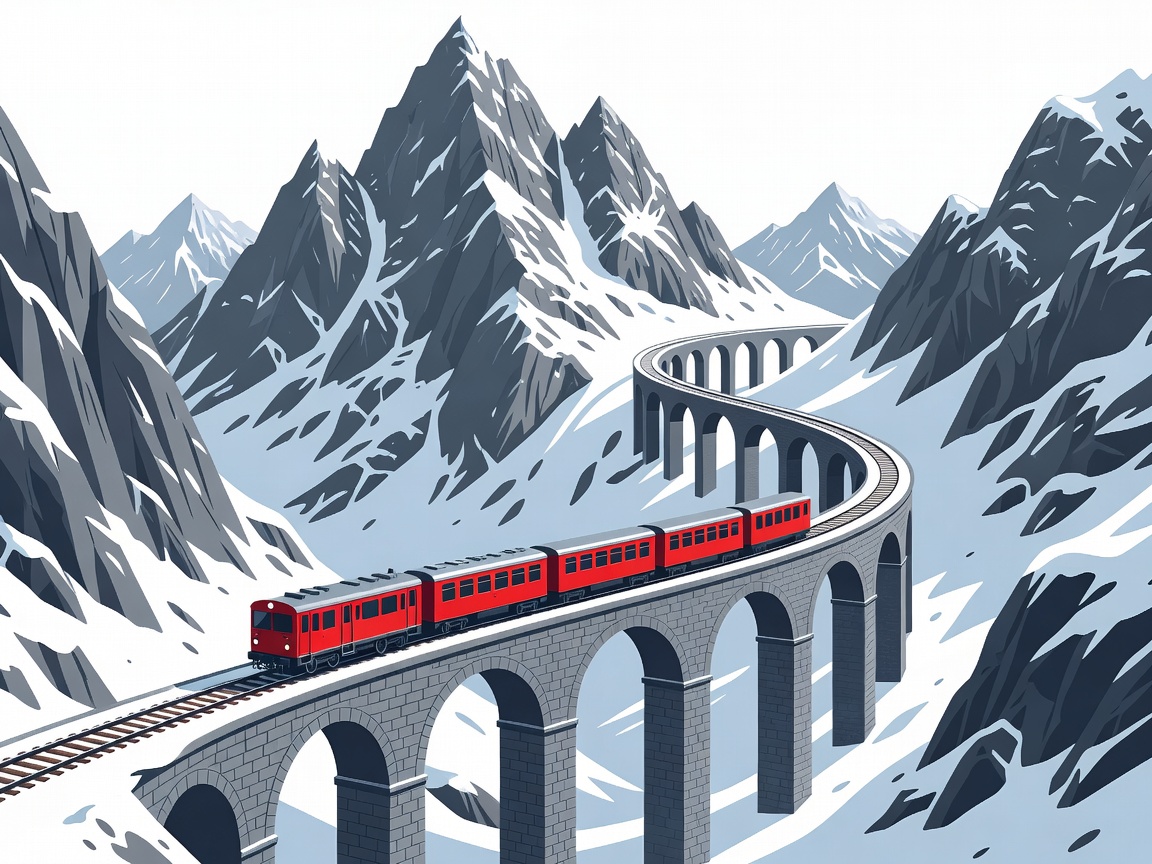
The Albula and Bernina lines were inscribed together as a UNESCO World Heritage Site in 2008. Highlights include the Landwasser Viaduct, the glaciers above Morteratsch and the circular viaduct at Brusio.
Glacier Express
- Zermatt – St. Moritz
- About 8 hours
- Oberalp Pass
Often called the slowest express in the world, it crosses the Oberalp Pass at about 2,033 m. It is a meal-and-panorama day rather than a fast connection.
Flåm Railway
- Myrdal – Flåm
- About 20 km
- Steep descent
One of the steepest standard-gauge adhesion lines in the world, dropping roughly 860 m past waterfalls such as Kjosfossen, where trains traditionally pause.
Darjeeling Himalayan
- New Jalpaiguri – Darjeeling
- 2 ft gauge
- UNESCO 1999
The "Toy Train" opened in 1881 and gains height through loops and zig-zag reverses, including the Batasia Loop near Ghum.
Stop by stop
The Bernina line, north to south
- ChurBoard early: panoramic coaches fill fast in summer.
- Filisur and the Landwasser ViaductThe train curves straight into a tunnel in the cliff face — best seen from the right-hand side heading south.
- Albula Tunnel and PredaSpirals and loops between Bergün and Preda gain height almost silently.
- Pontresina and MorteratschGlacier views open up on the right.
- Ospizio BerninaAbout 2,253 m, beside Lago Bianco; snow can linger into June.
- Alp GrümA short stop above the Palü glacier and the Poschiavo valley.
- Brusio and TiranoThe circular viaduct, then street running into Italy.
Scenic appeal versus practical reality
Panoramic coaches with roof-height glass are wonderful for wide views and hopeless for photographs into the sun: reflections and tinted glass are common, and windows rarely open. Many travellers ride the regional trains on the same tracks instead — slower to fill, often with opening windows, and usually without a supplement. You trade the commentary and meal service for flexibility.
Weather shapes everything. Cloud can sit on a pass all day, and in winter some lines run reduced timetables or suspend sections for avalanche control. Altitude affects some travellers too; at Jungfraujoch, take it slowly.
Service caveats
- Glacier Express seats require a compulsory reservation; rail passes usually do not include it.
- Bernina Express panoramic trains also need a paid reservation; regional trains on the line do not.
- Timetables change seasonally and engineering closures are common in spring and autumn.
- Check operator websites for current fares — we do not sell tickets.